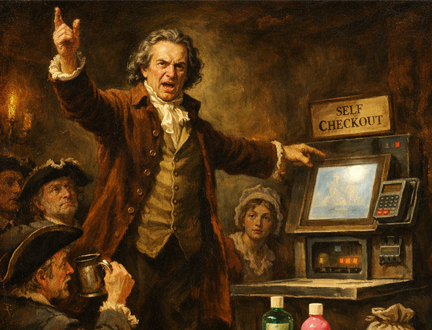
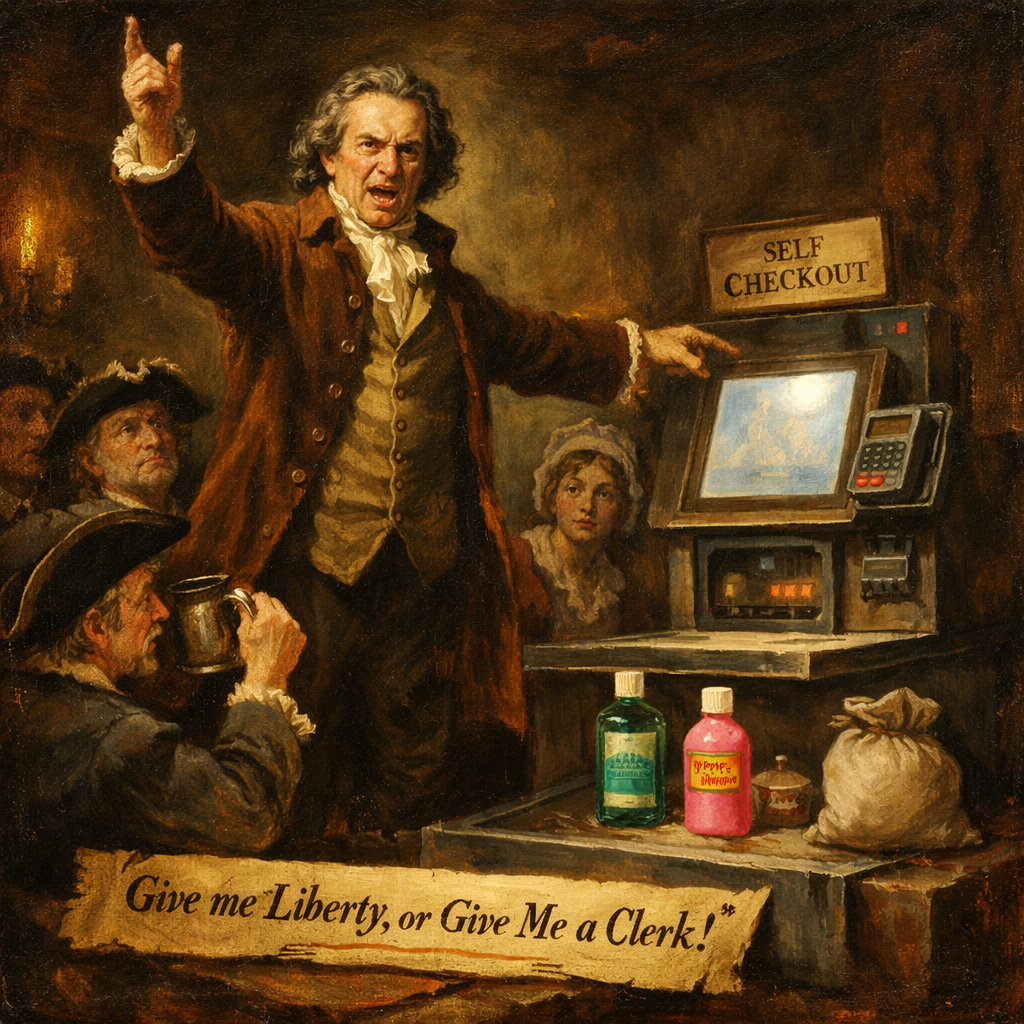
Thomas Paine Is Not Happy With Self-Checkout Machines
These are the times that try men’s willingness to buy Skittles
The self-checkout machine is an abomination! It makes a mockery of the labor that separates polite society from the tyrannical law of the jungle.
That a purportedly free people should submit themselves, willingly and without complaint, to a blinking monolith that demands obedience, errors without reason, and speaks of the “bagging area” in the hollow voice of a false oracle is a condition that no amount of convenience can excuse.
The defenders of this machine tell us it is progress. They tell us it is faster. They tell us it gives us control. Yet what sort of progress requires a man to perform labor while pretending he has been liberated from it? What sort of control demands waiting for an associate to come check your ID so you can buy mouthwash? What sort of speed requires an attendant to be summoned like death himself every time the machine deems a barcode perplexing.
In the natural order of things, a man selects his groceries and an occasional Pepto Bismo if he is afflicted with an upset tummy, and another man, trained for the task, completes the transaction with merely a perfunctory ask about a reward card and nothing more.
This arrangement served civilized society long before the days of electricity and receipts the length of the Old Testament, To disrupt this order is not innovation. ‘Tis confusion, and the spectre of decline wearing the mask of customer choice and convenience.
The scriptures have long instructed us on the nature of trials such as this. Job was made to suffer the loss of his home, his health, and his comfort, yet even in his affliction he did not need to ask an associate to help him purchase a Milk Duds value pack.
His faith was tested, not his ability to find the barcode on an Arizona Iced Tea. The Lord asked much of Job, but he did not interrupt him repeatedly to say that there is an “improper item in the bagging area”. The lord certainly never expected Job to search for fruit on a mystifying tablet that refuses to respond to the firm touch of a customer!
What offends me most is not the use of machines to improve the efficiency of shopping , but the quiet desperation it engenders in the people before it. We stand in line, eyes down, scanning and rescanning, accepting error messages as gospel. We wait patiently for assistance, grateful when a stranger swipes a card and taps a bunch of random numbers.
I am not so foolish as to believe these machines will vanish tomorrow, nor so vain as to think a single pamphlet can overturn a thoroughly researched business strategy once it has been established.
But I shall proclaim that any man who quietly accepts correction from a machine will soon accept correction from anything that speaks with authority. Habit will do the rest.
I ask only that a man, when offered the choice, choose to be treated as a customer rather than a clerk. Let him wait an extra minute. Let him endure a longer line. Let him look upon inconvenience and say, this I can bear, but indignity I will not.
By perseverance and fortitude we have the prospect of a glorious issue; by cowardice and submission, the sad choice of standing there awkwardly while the machine yells about “help needed at station 4.”

- About the Author
- Latest Posts

Connor Adams is a writer and television professional living in New York City. He is from New Jersey and has performed stand up all over the tri-state area and he loves you very much. His writing can be seen on Points In Case, Greener Pastures and Robot Butt.