Tips for Using Prompt Engineering on Your Lazy Husband
Ever since we started using Microsoft Copilot at the office, things have gotten so much easier at home. I discovered by accident that my husband responds well to the same kind of prompt engineering I use at work. “STOP HALLUCINATING AND DO THE SIMPLE TASK I GAVE YOU, YOU IDIOT!” I screamed in exasperation at my computer screen as I was drafting emails at the living room table on a Friday evening. I was quite surprised when my husband, who had been watching Cold Case Files on TV, said, “Okay, okay,” and got up from his recliner and took out the trash. What a game-changer! Discovering the power of using prompt engineering on my sloth of a husband has changed my life completely, and I will share these invaluable tools with all you overworked married people out there. Follow these simple rules for optimal results:
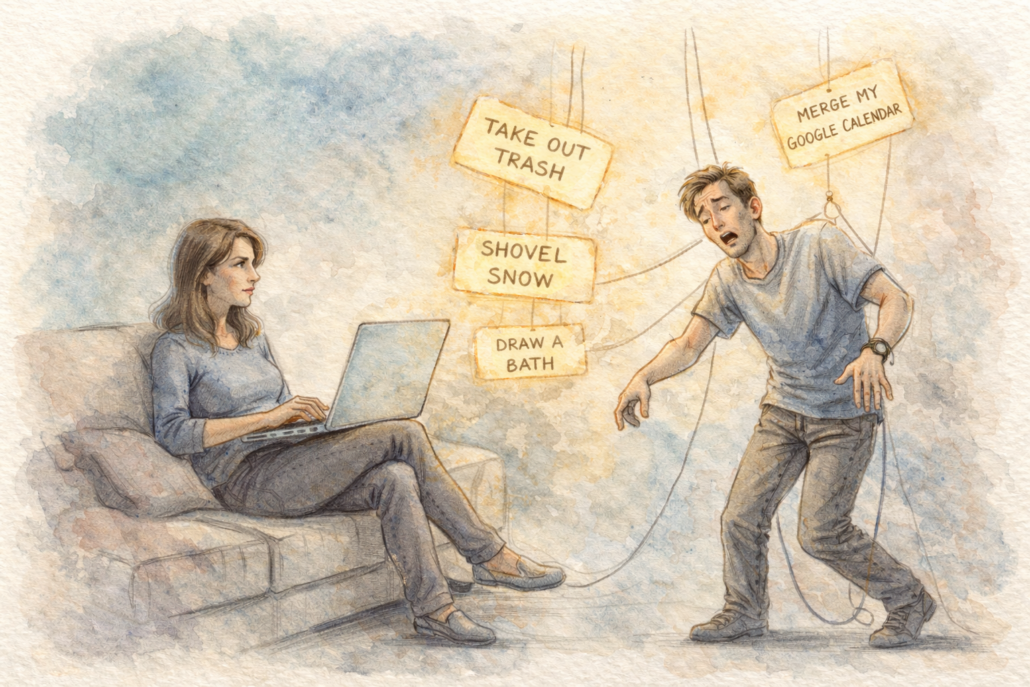
Rule #1: Be specific. The most important thing is to be explicit in your prompts. I once made the mistake of telling my husband that I don’t care how he does it as long as it gets done. Big mistake. Working with a large language model has taught me to be ultra-specific in my commands. Here are some templates for you to use in your prompt engineering: When I want a compliment from my husband, I will say something like this: I want you to write me a sincere note telling me how much you love me, and why. I don’t want compound adjectives, for they are unbecoming, and I don’t want any diminutives, for I am grand. Subtle racism is expected and encouraged. Now, before you begin composing your epistle of affection, I want you to read this volume of romantic love letters between famous lovers throughout history. Pay special attention to the letters between the Scottish poet and libertine Robert Burns and his sad, jilted lover, Nancy. You’re Nancy. Even a mechanical task, like drawing a bath, requires specifics: Draw me a warm bath. You must ensure that the water temperature is suitable for the HUMAN species, not just a random mammal. This time, I trust you will remember that I am not a grizzly bear who prefers icy rivers, nor am I a back-swimming otter who enjoys floating among kelp and broken-off branches.
Rule #2: Context is vital. Use this prompt to give him context: You are a serf wholly under my command. Questioning is immoral, and escape is futile. Now you can tell him to shovel the driveway. Or you can say this: They are promising rain this weekend, and you are destined by your fate as my consort to climb the ladder to success in your task of clearing the leaves out of the gutters. Don’t expect a “Thank you,” for we both know that pleasantries are a waste of electricity.
Rule #3: Give him the right tools to optimize your day. I always give my LLM and husband my calendar and say to him: Since you will do everything for me, I want you to merge my Google Calendar with yours and give me a bullet-point presentation of everything you will do for me. I will be waiting in my bath.
Rule #4: Flattery goes a long way. Any AI assistant flatters its delusional user, and you should encourage this behavior in your domestic partner as well. Use this prompt as your template: Put winter tires on the car. Before you start, I want you to read a book on basic mechanics and a romantasy novel for horny housewives and then merge the two to romance me as you change the tires. Don’t be afraid of making sleazy innuendos by using the car jack or the lube gun in a figurative, suggestive way. After a long, hard day of prompt engineering your husband, you’ll want him to make you feel like a whore.
Conclusion: Once you learn to view your husband primarily as a large language model, I guarantee your life will be as easy as a walk in the park. Use these prompt templates every day, and you, too, will become an expert prompt domineer engineer.
- About the Author
- Latest Posts

Jesper Soerensen is from Denmark and now lives in Miami Beach. He is the author of a book about one of the greatest humorists of all time: “Charles Dickens – The Stories of His Life” is out now from Olympia Publishers. You can find Jesper on Instagram: @soerensen.jesper