The World Cup Questions Most on Americans’ Minds This Week
I’ve been watching the World Cup. Why is the field so big and who are all the people on the field?
Believe it or not, they all belong there. And the field is just the right size to violate our expectations. By the time the offense has finished playing tic-tac-toe in midfield and also passed it back to the goalie a couple of times so he can feel “part of the action,” many of us are asleep and therefore miss what happens next: After repeatedly probing the defense for an hour, the offense figures out a way to get the ball in the “box,” where they are called instantly offside. If not, they immediately lose the ball to the other team. It’s reminiscent of a catering company elaborately preparing a meal for hundreds that they then casually drop in the trash.
Does anyone ever score a goal?
At some point, the offense makes a serious attempt to score, but 96.9 percent of the time, the ball is blocked, intercepted, kicked out of bounds, or is recovered by the other team. Another 2 percent of the time, the ball disappears altogether and needs to be replaced. The other team then proceeds to repeat the entire process going in the opposite direction. For some indeterminate amount of time, the game almost appears to halt as the teams on offense desultorily pinball the soccer ball around midfield, catching their breaths, and showing off their ability to pass accurately to a teammate while both are standing a few yards apart. Beautiful long crossing passes are frequently complete, but they too come to nothing. What was your question?
I counted the moments of exciting action in a recent 90-minute game and it came to less than 40 seconds. How do soccer fans cope?
They contemplate the many nuances of offensive and defensive alignments and spacing that elude most Americans, who are busy on their smart phones during much of the game.
Why do so many of the players keep collapsing and holding their ankles?
This is the game-within-the game. Each player competes for the honor of Most Convincing Injury Performance, or the Bloody Boot, the winner of which is chosen in a secret ceremony at the conclusion of the World Cup. It’s the most competitive aspect of soccer because any inadvertent collision or attempt to impede another player’s progress results in a whistle and a foul, of which there can be as many as three a minute. This results in a free kick, a yellow or red card, or a stern lecture from the referee in a language the miscreant doesn’t understand. However, in every case a foul leads to the sort of histrionics and performative agony on the part of the hurt party that is normally seen only in kindergarten classrooms right before a nap period. In the absence of anything else to root for, this charade of violence titillates true soccer fans, whereas we Americans prefer more impressive violence, actual damage, evidence of blood, and even career-ending injuries. The only thing sports historians compare to the sight of multiple soccer players falling down in unison to clutch their lower extremities is a Matthew Brady photograph of the Union dead at the Battle of Antietam.
Surely, they can design more protective shoes and shin and ankle guards that would prevent, or at least mitigate, this melodrama without obscuring the illegal contact that prompts the referee’s whistle.
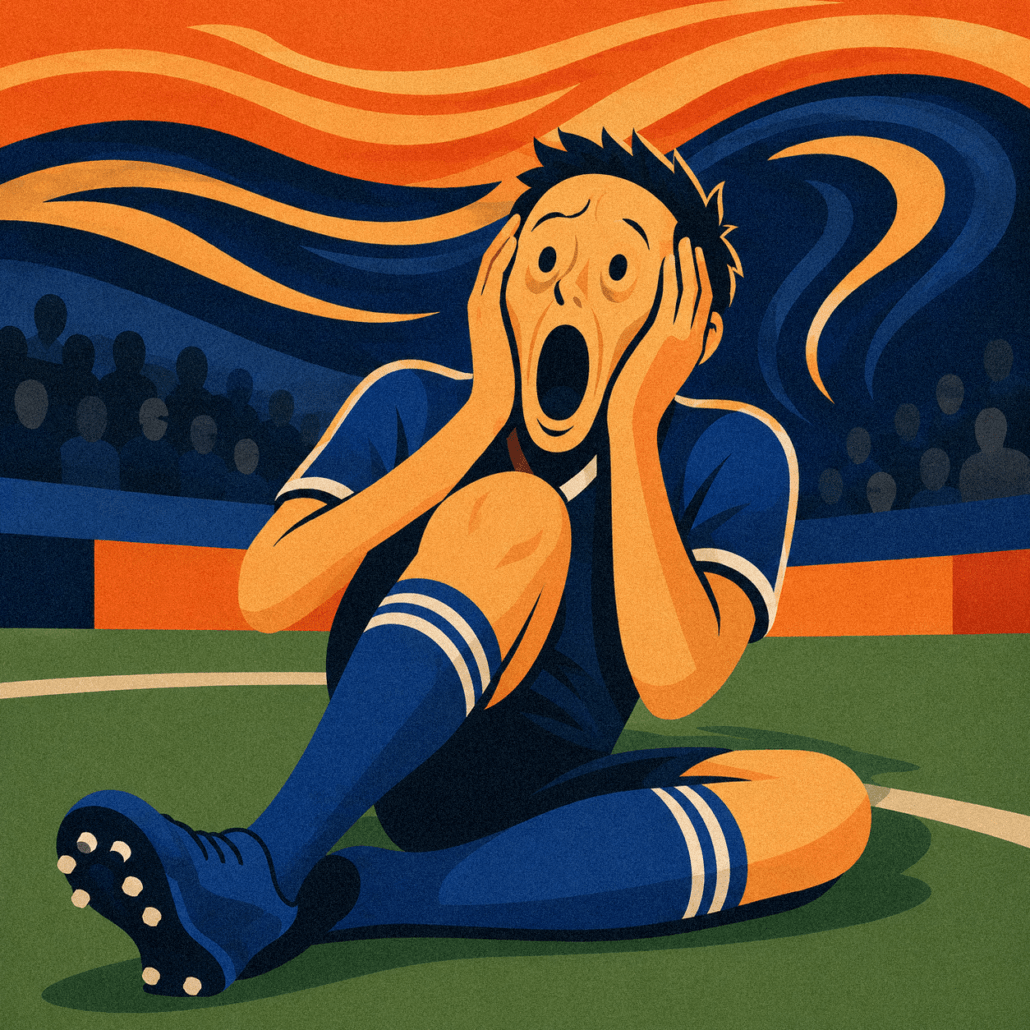
You would think. Anyway, only two times a match is a player carried off on a stretcher to attempt to lend credibility to his professed injury. Given the relentless TV close-ups of player’s grimacing and agonized expressions, there is talk of changing FIFA’s logo to a stylized image of Edvard Munch’s The Scream.
Back to the game. Why does it take so long to move the ball downfield?
Again, this is a direct result of too many men on the field, which is prohibited in American sports. While waiting for something better to happen, soccer players sometimes interrupt their game of keep-away by suddenly kicking a long ball to a teammate streaking toward the opponent’s goal. The last time this resulted in a goal was in the first round of the 1930 World Cup, making this maneuver nothing more than an empty protest against the congestion that mars their sport. It also may be a way for players to let fans know they can actually envision a more exciting sport than the one they are playing.
I understand why no offensive player can precede the defense into the big box. But why, when the offense does enter the box “onside,” is the offense yet again ruled offside because an offensive player touches the ball a millimeter or two ahead of a defender? Isn’t this like being acquitted of a crime and then being charged with it again the moment you leave the courtroom?
This rule is a reflection of other continents’ history of prolonged military struggles, especially The Hundreds Year War between England and France that began in 1337 and didn’t end until 1453. Drawn-out warfare was seen as the inevitable result of any conflict, and eventually as a virtue that could be exported to games like soccer. Originally, soccer rules prevented teams from ever winning games, which all ended in 0-0 ties. They still usually do, but the rules were rewritten at the 1863 founding of The Football Association in London to allow a goal or two, sometimes accidentally scored by a player on the other team.
Speaking of time, what’s with the highly impressionistic timekeeping? In what other self-respecting sport does the clock continue to run during injuries, disputes on the field, video reviews, water breaks, player substitutions, and the infrequent celebration. (Even baseball, which has no game clock, has instituted a 20-second pitcher’s clock to expedite the game.)
You failed to mention that, at the end of each half, the referee guestimates the amount of extra time that’s needed to make up for all those interruptions and adds them as “stoppage time.” Strangely, no official has really been keeping track since stoppage time is always rounded up or down to a full minute. And even then, the end of stoppage time is not marked by a horn or buzzer, but is allowed to go on until the current offensive action or attack is foiled.
Obviously, they have a clock, so why don’t they use it like Americans do? They should leave Impressionism to the French.
Well, clearly, the odds of any team scoring at any time are so infinitesimal that officials see no reason to be stick-in-the-muds about it. The feeling seems to be, “Why be such a stickler about such things? Didn’t everybody have a good time? That’s what counts.”
So why is a sport based on futility so popular?
I’m glad you finally asked. Futility, which is the essence of soccer,is also the essence of life, keeping unrealistic human aspiration in check and preventing everyone from getting too cocky. However, a competitive game in which nearly everything goes awry is a hard sell, so we must look for answers elsewhere.
- Soccer’s rare moments of tense action—near misses or, every couple of years, an actual goal—are easily observed and understood, so that’s a plus. No one in the stands says, “Wait—what just happened?”
- Another possible reason: most people on other continents are accustomed to rationing and higher rates of poverty. Since abundance is not second nature to most cultures, it may be that scoring—i.e., getting ahead—violates their sense of upward mobility.
In our country, NBA teams score around 70 baskets in a game, excluding free throws. Baseball games average almost 9 runs a game and 16 hits. Even NHL hockey games feature almost 6 goals a game and 56 goalie saves. NFL football? 46 points and 41 first downs. But a game like soccer in which almost no one scores may seem be a comforting reminder of life itself.
- But here’s the deeper reason for its popularity: To play soccer, all you need is a roughly spherical object, some other humans, and no alternative game.
Moreover, the essential physical action is second nature to the species. Almost everybody in the world over the age of two—and sometimes one—can kick a ball. However, few people outside of our continent, can throw a ball accurately with much velocity. The key to soccer’s popularity is the degree to which its fans can identify with the players, none of whom can throw or pass a ball properly with one hand.
Sadly, there is such an aversion elsewhere in the world to using one’s arms that soccer games come to a stop (and precious goals disallowed) if the ball just inadvertently grazes someone’s hand or arm. This anatomical bias makes no sense to Americans, but the global identification with feet and kicking is so reassuring that fans are willing to tolerate endless athletic futility on “the pitch”and also traveling long distances in face paint in order not to see their team accomplish much of anything.
Got it. But why do they make the substitutes wear ugly bibs? Do a lot of them have side gigs at Supercuts or as crossing guards?
It’s either that or they want to be first in line for the traditional post-game lobster meal in the clubhouse.
So how are you spending your time instead of watching the World Cup?
Are you kidding? I’m glued to it! Did you see Senegal blow a two-goal lead to Belgium in the last few minutes and lose the game altogether in extra time? And how Croatia tied Portugal in the very last second, but the goal was disallowed because it touched a single hair on a Croatian’s head, making his teammate, the goal scorer, offside? Epic!
- About the Author
- Latest Posts

R. D. Rosen is an award-winning bestseller and has written or performed comedy for PBS, HBO, and SNL. His most recent book is Tough Luck: Sid Luckman, Murder Inc., and the Rise of the Modern NFL, soon to be a documentary. The Golden Treasury of X-Rated Poetry by Cats is forthcoming from Humorist Books.