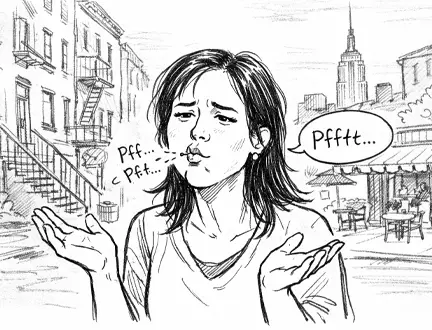
Random Thoughts I Had About Why I Can’t Whistle
I don’t have the whistling gene.
I grew up in a non-whistling household.
Actually, my dad and brother can whistle.
I grew up in a gender-biased, mixed-whistling household.
My family did not prioritize musicality during my formative years and focused too much on math.
Well, technically, they did drag me to piano lessons when I was seven. But the piano was clearly the wrong instrument. I should’ve been taking whistling lessons. Much more useful for getting people’s attention and hailing cabs. You can’t hail a cab with a piano.
Whistling conveys a sense of carefreeness and nonchalance.
I have never felt carefree or nonchalant.
Whistling in a carefree and nonchalant manner alerts the mysterious forces at work (the ones that control Murphy’s Law) that you are enjoying life a bit too much, and now, something bad must happen.
How “bad” depends on the level of exuberance displayed during whistling. The “bad” ranges from stepping on gum to a piano falling on your head.
Thus, whistling is risky.
I am risk-averse.
Often, people whistle while they are doing something, like washing a car, drilling a hole, or making friendship bracelets. Whistling requires multitasking, and I can only single-task.
As long as the single task is not whistling.
Whistling conveys cheerfulness.
Being cheerful is complicated, unless you are a cheerleader and it’s a requirement. If I had been a cheerleader, I would’ve known how to be cheerful, and whistling would’ve come naturally to me. My school didn’t have sports, so there were no cheerleaders.
- About the Author
- Latest Posts

Viktoria is a Boston-based writer of humor and children’s books. You can find her work in Weekly Humorist, McSweeney’s, Points in Case, The Belladonna, and Robot Butt, or schedule a private reading of select pages of her 3rd-grade diary.