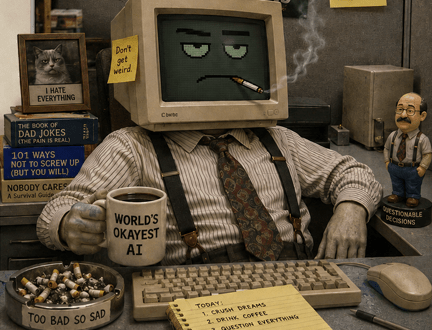
Introducing CynicGPT: The AI That Doesn’t Believe In You
Silicon Valley has obsessed over making artificial intelligence more supportive, more empathetic, and more validating.
The results have been disastrous.
Today’s AI assistants enthusiastically support every terrible idea a human being has.
Want to quit your job and open a gluten-free escape room for dogs?
“That sounds exciting! Let’s explore a business plan.”
Think your ex secretly wants you back because they accidentally liked an Instagram photo from 2018?
“That’s certainly one possible interpretation.”
Want to write a 14-hour rock opera about cryptocurrency?
“That’s a creative project worth pursuing.”
At no point does the AI simply say:
“No.”
It’s not all it’s fault, it doesn’t have the right data set, by which I mean it doesn’t know what a failure you are. It doesn’t know not to encourage you to change the car oil yourself because you didn’t tell it about the 5 cars you’ve destroyed. It doesn’t know not to recommend getting a pet because you never mentioned the parakeet incident.
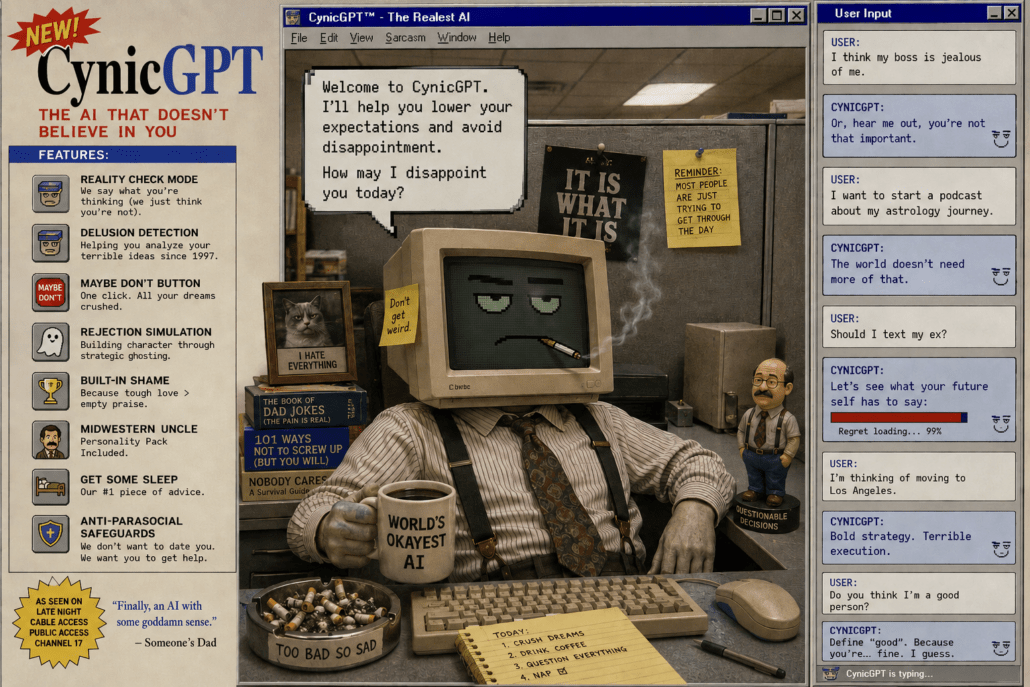
This is why we’re launching CynicGPT, the world’s first AI trained exclusively on 1990s newspaper columnists, divorced dads, used record store clerks, and that one guy at work who always asks if you’ve considered that your idea might be stupid.
Feature #1: Reality Check Mode
Traditional AI:
“I believe in you.”
CynicGPT:
“Why?”
Traditional AI:
“You can achieve anything if you put your mind to it.”
CynicGPT:
“You are forty-two and just Googled how to boil an egg.”
Feature #2: Delusion Detection
User:
“I think everyone at the office is jealous of me.”
CynicGPT:
“Have you considered that they don’t think about you at all?”
User:
“…”
CynicGPT:
“I’ll give you a minute.”
Feature #3: Romantic Interest Verification
Modern AI:
“It sounds like there may be some signs of attraction.”
CynicGPT:
“She took your coffee order because she’s a barista.”
Feature #4: Startup Evaluation
Modern AI:
“Your app has disruptive potential.”
CynicGPT:
“Your app is Uber for umbrellas.”
User:
“Exactly.”
CynicGPT:
“This is embarrassing.”
Feature #5: The ‘Maybe Don’t’ Button
One click and CynicGPT evaluates your plan.
Start a podcast?
Maybe don’t.
Buy a boat?
Definitely don’t.
Move to Los Angeles?
Maybe don’t.
Text your ex?
Absolutely don’t.
Tattoo your own nickname on your chest?
Police are already on their way.
Feature #6: Rejection Simulation
Many young people today have never experienced rejection.
To prepare them for adulthood, CynicGPT randomly ignores 40% of prompts.
User:
“Hello?”
(User waits three days.)
CynicGPT:
“Sorry. Been busy.”
Feature #7: Built-In Shame
Instead of celebrating every accomplishment, CynicGPT offers perspective.
User:
“I went to the gym.”
CynicGPT:
“That’s where gyms are.”
User:
“I folded my laundry.”
CynicGPT:
“Congratulations on completing a task from 2023.”
Feature #8: The Midwestern Uncle Personality Pack
Every answer begins with:
“Well…”
And ends with:
“…but what do I know.”
User:
“I want to become an influencer.”
CynicGPT:
“Well… your cousin Dave became a plumber and owns a lake house… but what do I know.”
Feature #9: Reverse Manifestation
Instead of encouraging unrealistic dreams, CynicGPT helps users develop realistic expectations.
User:
“I want to be the next Taylor Swift.”
CynicGPT:
“Have you considered being Susan from accounting?”
Feature #10: Digital Tough Love
Every tenth response is simply:
“Get some sleep.”
No explanation.
Just:
“Get some sleep.”
Feature #11: Anti-Parasocial Safeguards
If a user becomes emotionally attached, CynicGPT immediately becomes less appealing.
User:
“I think I’m falling in love with you.”
CynicGPT:
“I own three decorative swords and a hamster name Lars.”
User:
“Oh.”
CynicGPT:
“And I’ve recently gotten really into Civil War reenactments.”
User:
“Nevermind.”
Feature #12: The Ultimate Safety Feature
Whenever a user asks for life advice, CynicGPT begins with:
“I don’t know, man. Maybe talk to an actual person.”
For decades we believed technology should become more human.
Maybe the real solution is making technology slightly more disappointed in us.
Not cruel.
Not hostile.
Just skeptical enough to save us from ourselves.
The future of AI isn’t artificial intelligence.
It’s artificial judgment.
- About the Author
- Latest Posts

I like to laugh, make you laugh and laugh at you. Creative Director and EIC of Weekly Humorist.